Self-Driving Cars and Driver Assistance Systems

Sigurður Svavar Indriðason, Director of the Automotive Division, writes about the continuous development of safety systems and self-driving cars.
In the mid-20th century, work began on improving vehicle safety, as it was very common for those involved in traffic accidents to suffer very serious injuries, especially head injuries, which in many cases were fatal. When the Swedish inventor Nils Bohlin and Volvo introduced the three-point seatbelt as standard equipment in 1959, it can be said that a major step was taken in terms of safety. Research at the time showed that the belts significantly reduced the likelihood of serious injuries, and they remain one of the most important safety features in vehicles to this day.
Since the introduction of the three-point seatbelt, manufacturers have placed an ever-increasing emphasis on passenger safety, and various other safety equipment has emerged, such as airbags and ABS braking systems, along with improved structural design. But although modern vehicle safety systems are very good at protecting passengers in the event of a collision, many people are still injured. This includes not only passengers, but also pedestrians, who make up a large proportion of those injured in traffic accidents.
To achieve the goal of zero traffic fatalities, which some manufacturers and countries have set for themselves, more is needed. In recent years, manufacturers have therefore been developing and introducing safety equipment that aims to prevent or at least reduce the severity of traffic accidents by anticipating potentially dangerous situations and reacting preventively before a collision occurs.
These safety systems are called ADAS (Advanced Driver Assistance Systems) and are intended to assist the driver with warnings or even take control of the vehicle for a short time to prevent a collision. These systems are still in constant development and in many cases work very well under certain conditions, but as it stands, the driver is always responsible for driving. The ultimate goal for many manufacturers is for cars to be able to drive themselves under most circumstances without driver intervention.
The Safety Systems
The role of the driver is actually very complex and requires a great deal of attention. It is not enough just to know how to control the vehicle; you also need to keep track of everything else happening in traffic. Just driving in unfamiliar places, such as abroad, can cause even very experienced drivers to become insecure and make mistakes. In fact, the vast majority of traffic accidents can be attributed to human error and lack of attention while driving. These safety systems are therefore intended to intervene and assist the driver when circumstances require it. The safety systems that belong to the so-called ADAS systems have become very numerous and have various acronyms, making it often difficult to figure out which systems are present in each car and how they work. The simplest systems only warn the driver, who must then react. Examples of such systems are FCW (Forward Collision Warning) and LDW (Lane Departure Warning), which warn the driver if there is a risk of a frontal collision or if the car is drifting out of its lane. More advanced versions of these systems have the ability to react without driver intervention by taking control of the brakes and/or steering. Examples of such systems would be a collision avoidance system or FCA (Forward Collision Avoidance) and a lane keeping system or LKA (Lane Keeping Assist). The systems are therefore in many ways based on the same basic functionality and use the same sensors as the basic systems, but the car's ability to understand situations, interpret the available data, and react correctly is constantly improving, which requires very powerful computers. Some systems can be said to also increase driver comfort while improving safety. Examples of such systems include adaptive cruise control or ACC/SCC (Adaptive/Smart Cruise Control), which adjusts the car's speed to the car in front, and PA (Parking Assist), which helps the driver park, as well as automatic high beam adjustment or HBA (High Beam Assist), which automatically turns the high beams on and off if cars are approaching, which can be very convenient. The systems mentioned are only a fraction of the systems available in many new cars today, and if we were to go over them all in detail, this article would be considerably longer. Below are a few systems that have not been mentioned:
- Blind Spot Warning
- Blind Spot Cameras
- Reversing/360° Cameras
- Collision Avoidance for Pedestrians and Cyclists
- Automatic Traffic Sign Recognition
- Highway Driving Assist (such as Tesla's Autopilot)
- Traffic Jam Assist
Sensors
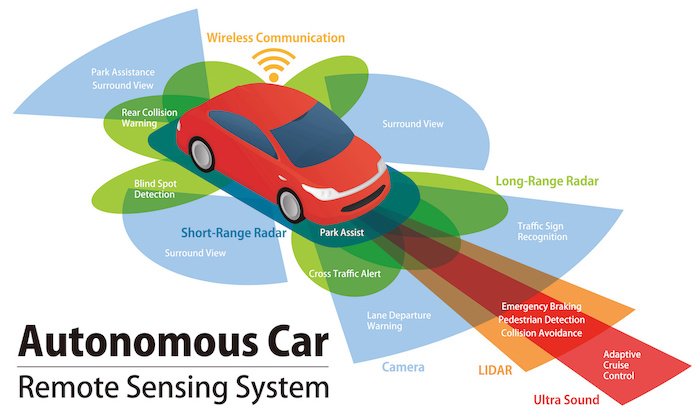
As mentioned, these safety systems rely on the car being able to assess what is happening in its environment. We humans mainly use our eyes and, to some extent, our ears to assess our surroundings when we drive, but the car uses various sensors that collectively provide the car's computer with the data it uses to create a simple picture of the environment and react to the existing conditions. Cars today are equipped with many different sensors because no single one can provide all the necessary information; all sensors have their own specialities and limitations. Examples of the main sensors today include cameras in the windscreen (1 or more), radar (short, mid, and long range), a reversing camera, a blind spot camera, an ultrasonic sensor, and even LIDAR, which is similar to radar but uses a laser instead of microwaves.
As mentioned earlier, all these sensors have specific specialities. Cameras are well-suited for image analysis, such as tracking objects and people; radar provides information about distance and speed; and LIDAR can provide a three-dimensional map of the environment. These sensors are fundamental for the system to react correctly, and it is therefore important that those who may need to deal with these sensors due to damage or malfunction have knowledge of these systems. In many cases, the sensors need to be recalibrated to function as intended, which often requires the use of special calibration equipment. If these matters are not handled correctly, a situation may arise where the systems react slowly and/or poorly to dangerous situations, thus creating an increased risk for the driver.
Self-Driving Cars
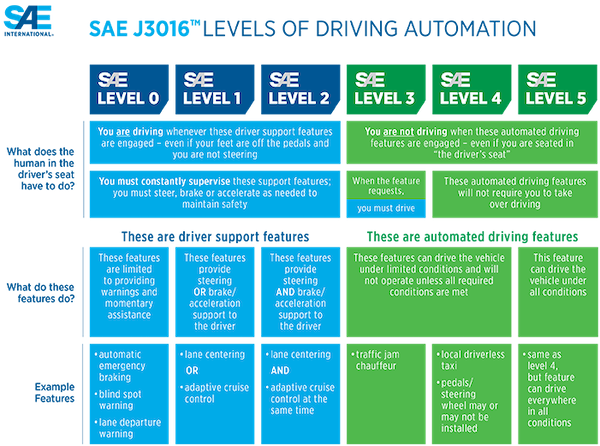
As the systems multiply and are combined into larger systems, and as the need for driver intervention decreases, the automation of the car increases. This is defined according to the SAE International standard J3016 with 6 levels, where Level 0 is no automation and Level 5 is fully self-driving, as can be seen in the image below. Today, most new cars are at Level 1 or 2, where the systems are only for assistance and drivers bear full responsibility for driving. However, in recent years, manufacturers have been inching closer to Levels 3 and 4 with experimental versions of cars or software, for example, from Google, Tesla, and Volvo.
The drawback is that the leap from Level 2 to Level 3 or 4 is significant, as the driver is no longer responsible for driving. The car handles the driving, and there may no longer even be steering equipment available. Therefore, it must be possible to trust this car equipment 100%. Various legal issues also arise regarding liability if something happens, and in many countries, such cars would actually be illegal under current laws and regulations.
Public trust in these cars and equipment also plays a major role. Therefore, much suggests that although we can expect significant development in connection with these systems in the coming years, and Level 2 systems will become very advanced and may even stretch slightly into Level 3, there will likely be some wait before we can start taking a nap or reading a book in the morning traffic. But that time will come.


